
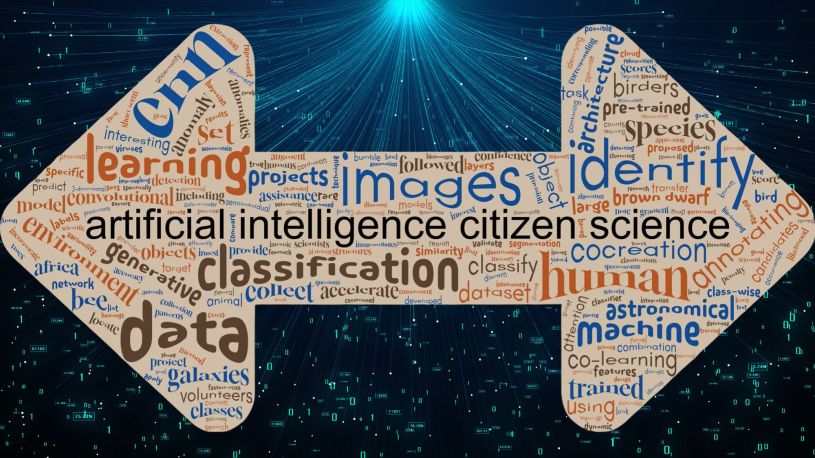
We wanted to share with all of you the exciting news! The journal “Citizen Science: Theory and Practice” has just published a special collection of articles: “AI and the Future of Citizen Science”. Six of the 11 papers in the collection feature Zooniverse projects: Backyard Worlds: Cool Neighbors, Galaxy Zoo:Weird & Wonderful (now paused), Gravity Spy, Jovian Vortex Hunter (now finished), Science Scribber: Virus Factory (now paused) and Snapshot Safari projects.
This special collection was led by Zooniverse leadership team member Lucy Fortson from the University of Minnesota. An opening editorial by Lucy and colleagues provides a detailed explanation of how AI (artificial intelligence) and ML (machine learning) have been used to enhance crowdsourced research and human learning, and provides a comprehensive overview of all 11 articles.
For the Zooniverse articles in particular, researchers are using AI to identify or locate specific objects in images for various scientific purposes: for example, to find viruses in cell images with the Science Scribbler: Virus Factory project (Pennington et al., 2024), identify rare animals in the Serengeti with the Snapshot Safari projects (Heubner et al., 2024) or explore hard-to-spot astronomical objects like brown dwarfs in the Backyard Worlds: Cool Neighbors project (Meisner et al., 2024).
Other Zooniverse articles focus on the ways AI and humans can work together to solve scientific problems. Østerlund et al., 2024 use the gravitational wave project (Gravity Spy) to study how machines and humans can best learn from each other. Mantha et al., 2024 explore how human intuition and machine anomaly recognition can be combined to detect unusual astronomical objects in large datasets with the Galaxy Zoo: Weird & Wonderful project, and Sankar et al., 2024 use data from the Jovian Vortex Hunter project identifying cloud types on Jupiter to learn whether AI can use lack of consensus in volunteer responses to learn something about novel relationships within the dataset.
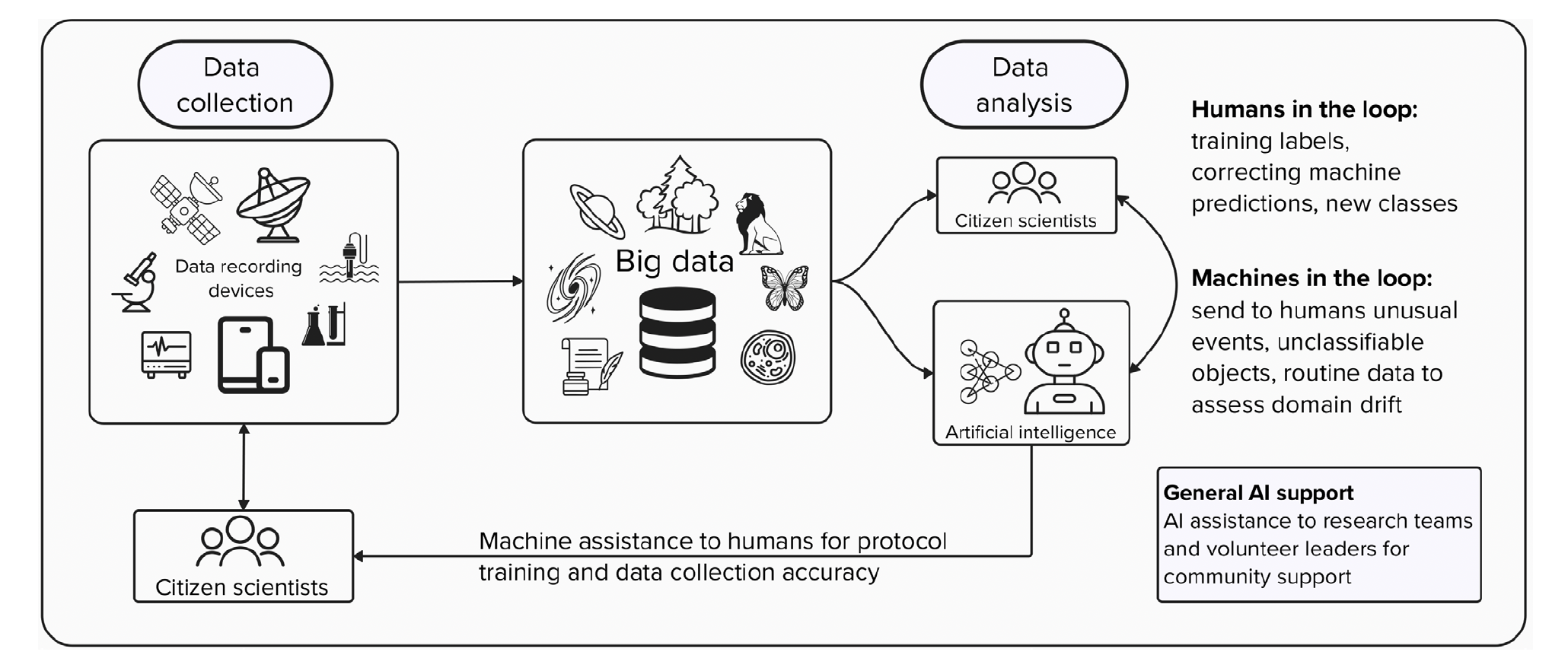
The other five articles explore topics such as using AI to help citizen scientists in Africa detect harmful mosquitoes or snails, or improve bee identification in the UK, or ask whether AI-based projects can help participants learn new information of interest – for example, helping novice birders to identify different types of birds. Finally, citizen scientists can learn about AI itself whilst working on the projects that use AI to solve issues relevant to them.
This collection of articles is a significant achievement for the whole Zooniverse community and a great opportunity for everyone involved with Zooniverse to reflect on how the general citizen science research community is thinking about the opportunities provided by AI, as well as the many concerns and challenges. It is also an occasion to celebrate the cutting-edge discovery our amazing volunteers and research teams contribute to on a daily basis. Congratulations, everyone!
Read all the articles in open access following this link: https://theoryandpractice.citizenscienceassociation.org/collections/ai-and-citizen-science or take a look at the editorial accompanying the special collection to learn more about these topics, as well as some basics on artificial intelligence.
As we all learn to navigate this brave new world with AI, we hope you find the articles interesting and informative. As always, if you have follow-up questions or concerns, please feel free to post on a specific project Talk board or one of our Zoo-wide Talk boards. You can also email us at contact@zooniverse.org.
Written by Lucy Fortson, Sam Blickhan and Alisa Apreleva
 Daily Zooniverse