
A new peer-reviewed article, Empowering Diverse Faith Communities through Engagement in Participatory Science, co-authored by Grace Wolf-Chase (Planetary Science Institute), Katharine Hinman (Director of the AAAS Dialogue on Science, Ethics, & Religion), and Laura Trouille (Zooniverse PI), contributes to our understanding of participatory science and faith communities. Read on for main insights from this work.
Engaging Faith-based Communities in Citizen Science through Zooniverse was an 18-month initiative designed to support faith-based communities participation in scientific research through projects on the Zooniverse platform. The initiative provided models for how Zooniverse could be used in seminary classes; with youth and family programs; and by interfaith organizations, particularly those such as Faith in Place, that are dedicated to advancing environmental and racial justice. Evaluation of the initiative indicated that sustained engagement by scientists beyond the Talk discussion boards is essential in building trust and participants’ confidence in their abilities to contribute to scientific research.
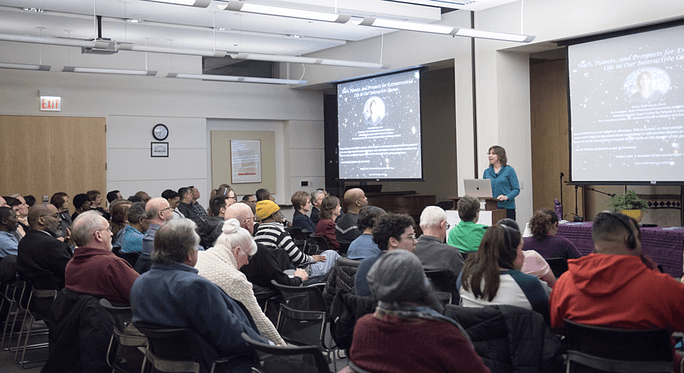
Initiative director Grace Wolf-Chase was invited to speak about participatory science as part of a special Science and Religion track organized by the Institute on Religion in an Age of Science at the 2023 Parliament of the World’s Religions. The Parliament presentation led to an invitation to contribute an article to the Zygon: Journal of Religion and Science, a journal widely read by scholars in both the sciences and the humanities, which is “dedicated to the manifold interactions between the sciences and human religious and moral convictions.”
The resulting peer-reviewed article, Empowering Diverse Faith Communities through Engagement in Participatory Science, is co-authored by Grace Wolf-Chase (Planetary Science Institute), Katharine Hinman (Director of the AAAS Dialogue on Science, Ethics, & Religion), and Laura Trouille (Zooniverse PI). The journal is open-access. Readers are welcome to download the article and share it with anyone who might be interested in ways participatory science can be used to help bridge cultural divides and engage individuals in a range of learning environments. If you’re a researcher leading a Zooniverse project and interested in broadening your audience, feel free to contact Grace through the links supplied below.
A few important takeaways from Engaging Faith-based Communities in Citizen Science through Zooniverse:
- Bringing participatory science experiences into community settings is best done through ongoing partnerships between scientists and community leaders. This builds trust, understanding, and synergies that integrate scientific content with theological or ethical concerns.
- Perceived views of science as anti-religion negatively impacts participation by diverse communities in science. Scientists within faith-based communities have a critical role to play in building bridges of trust.
- Working together, scientists and faith-based leaders can help broaden participation in science as well as ensure that science and its applications are more responsive to the concerns and priorities of all people.
Grace Wolf-Chase is a Senior Scientist & Senior Education and Communication Specialist with the Planetary Science Institute. Her primary research interests are the origins of stars and planets, and she is one of the co-founders of Zooniverse’s Milky Way Project. In addition to research, a principal focus of her career has been bridging academic and public conversations on science and religion. She was elected a 2024 American Astronomical Fellow for “outstanding and sustained work to bring the wonders of astronomical research to the general public, especially to diverse religious communities; and for significant investigations into bipolar molecular outflows within star-forming regions through multi-wavelength observations and analyses.”

Written by Grace Wolf-Chase, Laura Trouille and Alisa Apreleva
 Daily Zooniverse