

Hello from the Science Scribbler team! We are here with some exciting news about a project we’ve been working on for quite a while now: Virus Factory in Schools.
What is it?
Virus Factory in Schools in its current format is a spin off from a very successful “Zooniverse in Schools” programme run by the Zooniverse team based at the University of Oxford, in collaboration with the Science Scribbler team. We took the Science Scribbler: Virus Factory project, and together we modified it to be used as part of a series of workshops for schoolchildren aged 9-11. These were a big hit among the students, so to make these workshops accessible to more teachers and more children, we created a teacher resource pack containing all the materials needed for any educator to deliver the workshops themselves.
What do the workshops cover?
The three core workshops are designed using the science capital teaching approach. They discuss viruses, microbiology, citizen science, and how scientists use computers and microscopes to help them with their research. The main focus is on encouraging students to consider themselves as scientists, and show them that they are capable of making meaningful contributions to real research through citizen science.
The final workshop in the core series has a space built in for a Q&A with scientists. We are committed to supporting this portion of the workshops long-term, and our first live online researcher Q&A will take place on the 19th July 2024. Excitingly, we are planning to offer some in-person activities on Harwell Campus (where our team is based, and where the Virus Factory dataset was collected!) for classes who complete the workshops in the next school year.
What did the children think?
We hope to write up our findings and share them via a publication in the future, but here is a sneak peek of the results we’ve found so far:
Increasing students’ knowledge of citizen science
We compared survey responses from students at the start and the end of the core workshop series. At the start of the workshops, the majority of students answered with “neutral” or “disagree” when given the statement “I am aware of what citizen science means”. However, the majority answered with “agree” or “strongly agree” to the same statement at the end of the workshop series.
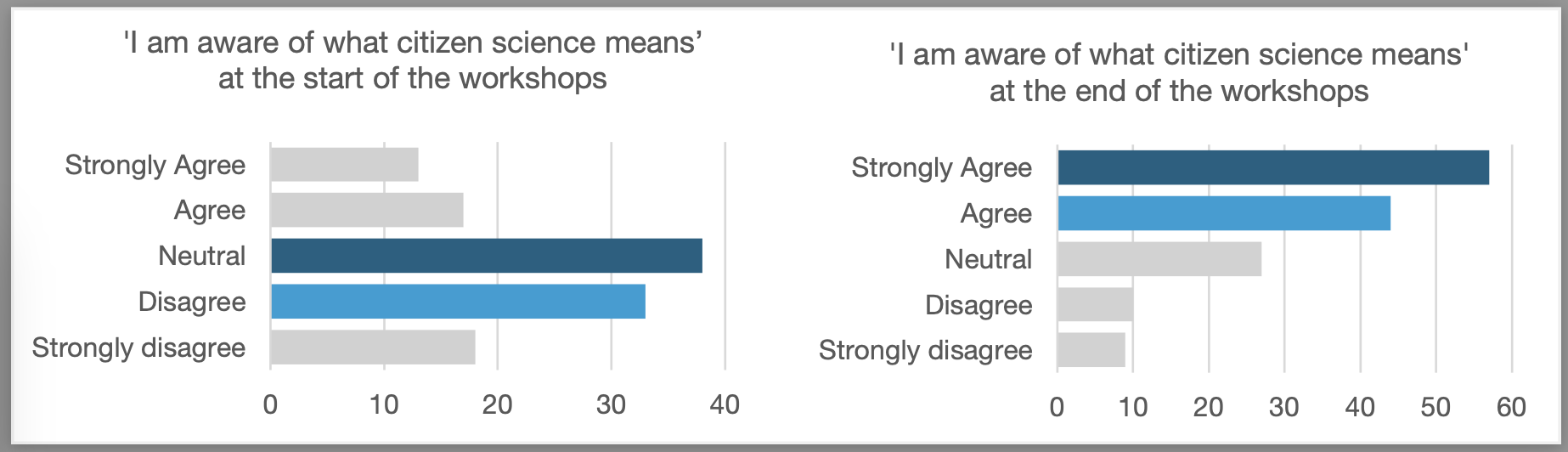
Figure 1: Students’ answers to the survey statement “I am aware of what citizen science means” before (left, n=119) and after (right, n=146) completion of the 3-workshop series and live researcher Q&A
Initially, when asked how they would describe a research scientist, the most common answer was a variant of “they research science” or “they research things”. Words were less personal, more objective (the top 5 by frequency: research, science, things, smart, viruses). After the workshops and the Q&A with researchers, the language was more subjective and emotive (cool, fun, research, smart, interesting). See below for the full word clouds:
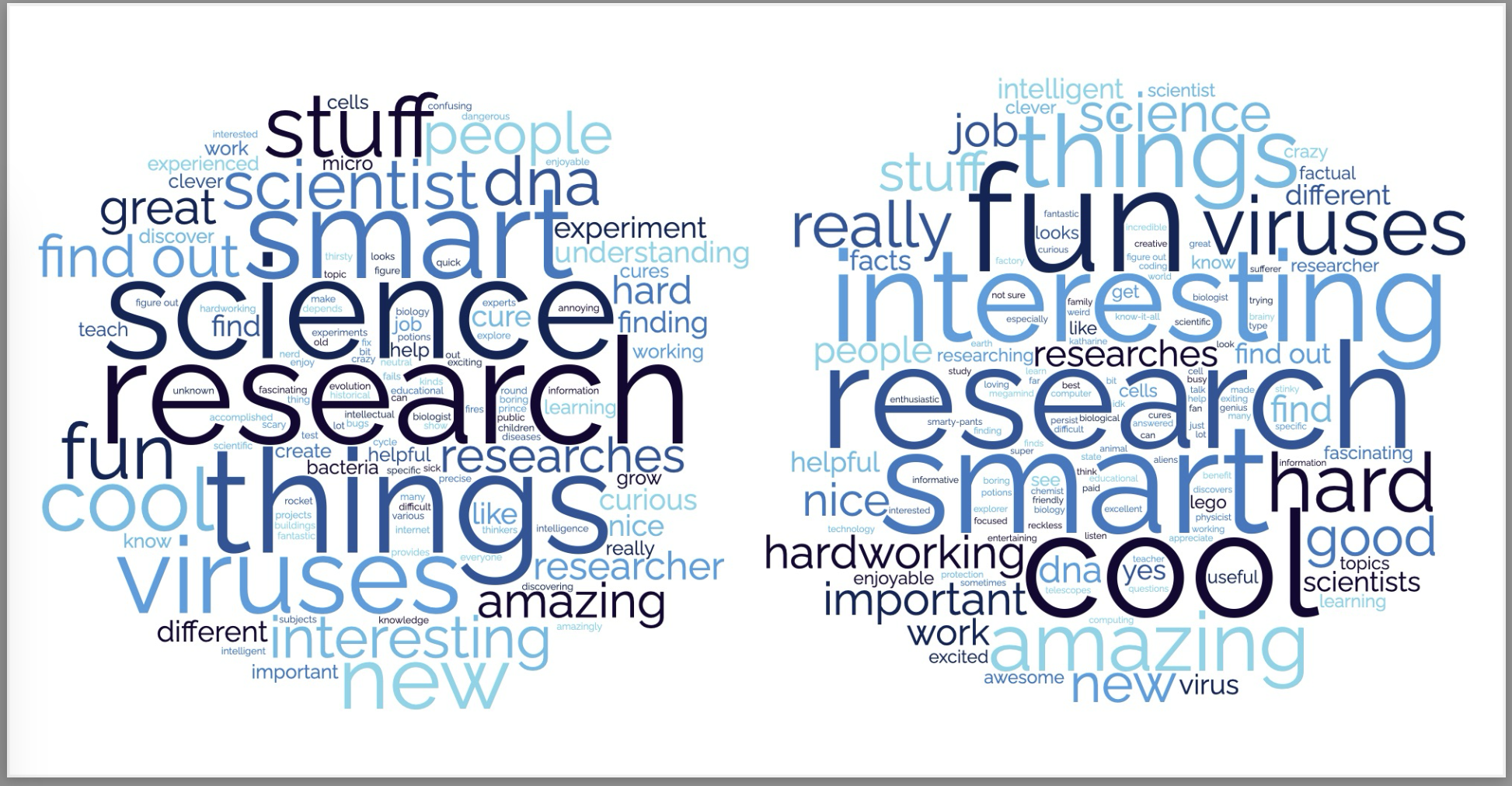
Figure 2: Students’ answers to the survey question “How would you describe a research scientist? If you are unsure, try to find two or three words to describe the job you think they do.” before (left, n=119) and after (right, n=146) completion of the 3-workshop series and live researcher Q&A
Can primary school children contribute high quality classifications in biomedical citizen science projects?
We have carried out some preliminary analysis comparing the classroom to the crowd, and the results are very exciting! The figure below shows an example of the annotations from one of the project workflows which was used both in the workshops with children aged 9-11, and in general outreach activities with the UK public.

Figure 3 Top: Cluster centroids (cyan), for crowd and classroom groups. Bottom: Annotations were assigned as outliers (red) or as members of individual clusters (not red).
As you can see, the consensus annotations (cluster centroids, cyan) are very similar between the two groups (note that the number of annotators in the classroom was about 1/3 of the number from the public). We are hoping to conduct a more widespread and quantitative analysis of the full 17,000 classification dataset in the future, so keep an eye out for that!
How can I get my hands on a teacher resource pack?

Figure 4: The Virus Factory in Schools resource pack.
If you are interested in receiving a free resource pack for your classroom like the one shown above, please fill in this interest form. If you have any questions about the resource or its contents, you can find more information on the project landing page, and the Science Scribbler team would be happy to answer any further questions via email. We will also be hosting drop-in sessions in the summer, where we can answer any questions you have before teaching begins again in September.
What are the next steps for Virus Factory in Schools?
We would love to create more education resources like this for our other Science Scribbler projects in the future. If you are an educator interested in testing new resources, providing feedback on the current pack, or in co-design of future materials, we would love to hear from you!
Currently, we have no plans to translate the resources into other languages, but we would love to collaborate with you if you are interested in helping with translation. We also have a curriculum mapping document for the national curricula of England, Scotland, and Wales, but would welcome any additional mapping to other curricula!
We hope that the activities we have planned for the next academic year are a huge success, and we can continue to fund and run the activities for many years to come.
Thank you and we hope you get in touch!
Tricia and the Science Scribbler team
 Daily Zooniverse