

A peer-reviewed article, Crowdsourcing Star-Formation Research and the Power of Participatory Science, was published as a part of the 2024 Astronomy Prize Awardees Collection in the Springer Astrophysics and Space Science Journal. The article details the Milky Way Project’s contributions to our understanding of star formation and describes how Zooniverse projects have been used to engage different communities, such as seminaries, youth, and interfaith groups, in participatory (“people-powered”) science. The publication is co-authored by 2024 American Astronomical Society Fellow Grace Wolf-Chase (Planetary Science Institute) and colleagues Charles Kerton (Iowa State University), Kathryn Devine (The College of Idaho), Nicholas Larose (Iowa State University), and Maya Coleman (The College of Idaho).
“Yellowballs” discovery
Research enabled by volunteer identifications of “yellowballs” (YBs) in the Spitzer Space Telescope images that were used in the Milky Way Project is a principal focus of the article. Most YBs highlight the positions of embryonic (developing) star clusters. They are helping the researchers to distinguish between the types of interstellar environments that produce massive stars and those that do not. This is important because stars greater than about 8-10 times the mass of our Sun eventually explode as supernovae and enrich their environments with heavy elements produced through nucleosynthesis. Our Solar System is thought to have developed in such an environment. The composition and evolution of planetary systems that develop in the company of massive stars are likely to differ from those that do not. Understanding these differences may be key to understanding the diversity of exoplanets.

Yellowballs (YBs). Typical YBs are compact and appear yellow in Spitzer 4.5 (blue)-8.0 (green)-24 (red) 𝜇m mid-IR images used by the MWP.
Tolkien and Astrophysics
The Mid-InfraRed Interstellar Objects and Nebulae (MIRION) Catalog of YBs was assembled from 6176 YBs identified by Milky Way Project volunteers. The paper reporting the properties of these objects has been accepted for publication in the Astrophysical Journal. Tolkien fans may recognize the word “Mirion” as Sindarin Elvish for the Silmarils, the jewels used to craft the Elven rings of power. Although the Milky Way Project is not currently active, astronomy instructors may be interested to learn how they and their introductory astronomy students can contribute to the ongoing study of these star-forming “jewels” through the People Enabling Research: a Yellowball Survey of the Colors of Protostellar Environments (PERYSCOPE) project.
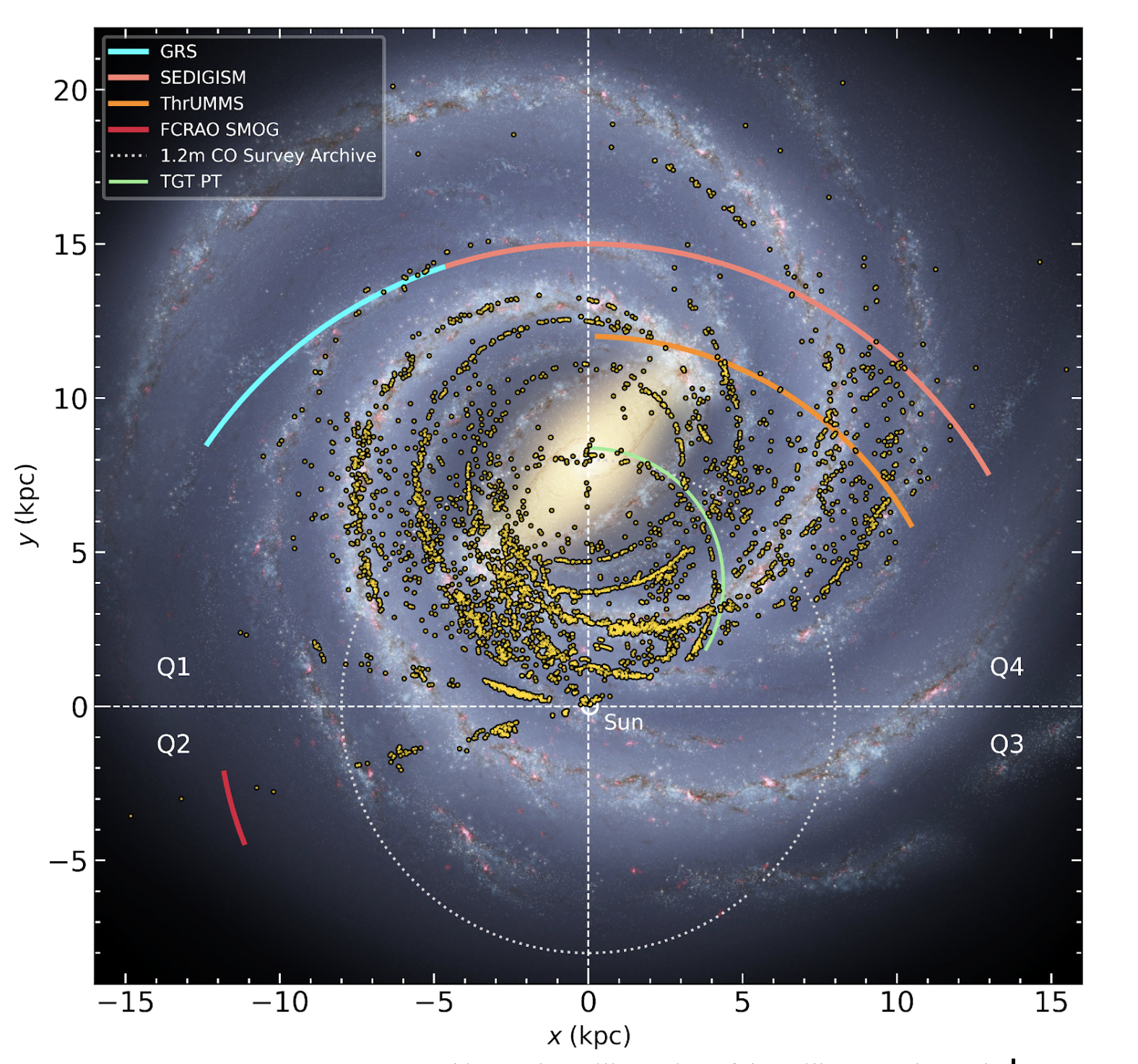
Distribution of YBs in the Milky Way. This top-down illustration of the Milky Way shows the location of all 6176 YBs (yellow-filled circles) that were identified by Milky Way Project volunteers. The colored arcs indicate spectral-line surveys the team used to determine distances to YBs. The Spitzer survey data used in the Milky Way Project was mostly confined to quadrants Q1 and Q4, which is why no YBs appear in Q2 and Q3 (except for the “SMOG” region).

Contact author
Grace Wolf-Chase (gwchase@psi.edu) is a Senior Scientist & Senior Education and Communication Specialist with the Planetary Science Institute. Her primary research interests are the origins of stars and planets, and she is one of the co-founders of Zooniverse’s Milky Way Project. In addition to research, a principal focus of her career has been bridging academic and public conversations on science and religion. She was elected a 2024 American Astronomical Fellow for “outstanding and sustained work to bring the wonders of astronomical research to the general public, especially to diverse religious communities; and for significant investigations into bipolar molecular outflows within star-forming regions through multi-wavelength observations and analyses.”
Written by Grace Wolf-Chase
 Daily Zooniverse